When AI Companies Become Services Companies
3 July 2026
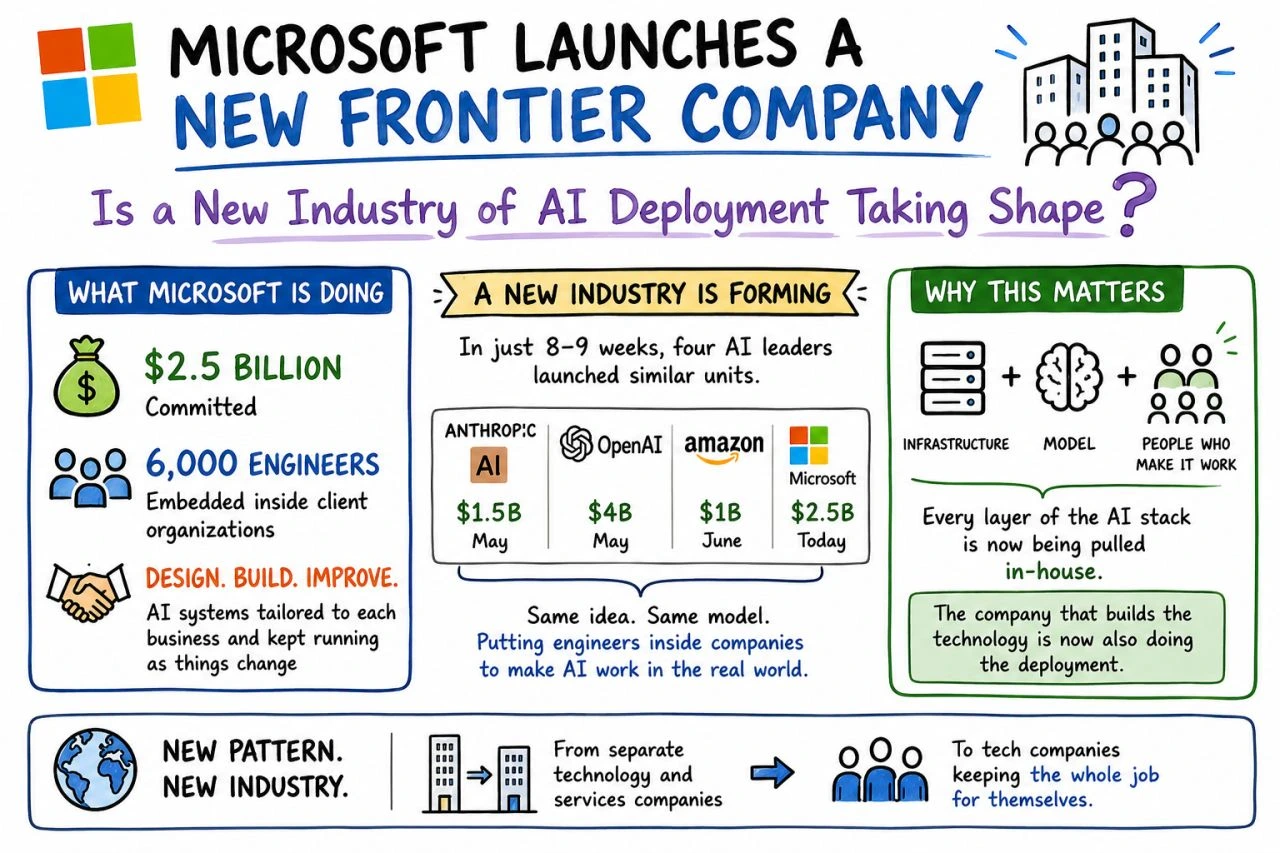
Microsoft announced a new Frontier Company on July 2, committing $2.5 billion and 6,000 industry and engineering experts who will work directly with client organizations to build and run AI systems. These experts won’t just sell Microsoft’s AI tools (the approach appears to be model-agnostic). They will work inside client companies, help design the right AI setup for their specific business, build it, and keep improving it as things change.
This isn’t a one-off development. Anthropic did something similar first, teaming up with Blackstone, Hellman & Friedman, and Goldman Sachs in May to launch a $1.5 billion firm that puts its engineers inside client companies the same way. OpenAI followed days later with a $4 billion “Deployment Company” and 150 engineers ready on day one. Amazon committed $1 billion to the same idea in June. Four major AI companies built the same kind of unit within 8–9 weeks of each other.
It would be a stretch to think about this as four companies landing on the same idea by chance. By the looks of it, that’s a new industry forming right in front of us.
Every big wave of computing has created its own services business around it. Mainframes gave rise to IBM Global Services. ERP systems gave rise to Accenture and the big consulting firms. Offshoring gave rise to TCS, Infosys, and Wipro. Each time, the pattern was the same: one company builds the technology, and a separate services industry grows up around helping companies actually use it. That services layer made a lot of money because using the technology well was harder than building it.
Now technology companies going into deployment (read: services) breaks that pattern. In the past, the company that built the technology and the company that helped you use it were different companies. This time, Anthropic, OpenAI, Amazon, and Microsoft are keeping that whole job for themselves instead of leaving it to traditional services companies.
The technology used to need a translator. Now every layer of the AI stack is being pulled in-house—infrastructure, model, and now the people who make it work.
References:
- Microsoft — Frontier Company: AI engineering that amplifies and protects your intelligence (2 July 2026)
- GeekWire — Microsoft unveils $2.5B Frontier Company to embed AI engineers inside customers
- TechCrunch — Amazon launches new $1 billion FDE organization, following OpenAI and Anthropic