Enterprise AI: What Happens When You Lose Control?
2 July 2026
I had the privilege of being at Walmart Global Tech India yesterday, sharing some thinking on careers in the age of AI with a sharp and engaged room (thanks Shiny Samuel, Aishwarya Iyer, and Bhuvan Gandhi for the opportunity).
Among many ideas, one core idea that we discussed was reversibility.
When your workflows become deeply tied to frontier AI models (hosted elsewhere), what happens when those models go down, or become unavailable, or simply become unaffordable overnight? Do you have an alternate path that lets you continue producing value?
Workflow lock-in is not a hypothetical. It is a live risk in the minds of enterprise leaders.
Which is why I read Palantir CEO Alex Karp’s comments on CNBC’s Squawk Box yesterday with quite a bit of interest. Three things from that interview stood out to me.
First: AI models have been irresponsibly oversold. Karp’s words, not mine. Enterprise leaders were promised transformation, received token bills, and are quietly angry about the gap between those two things.
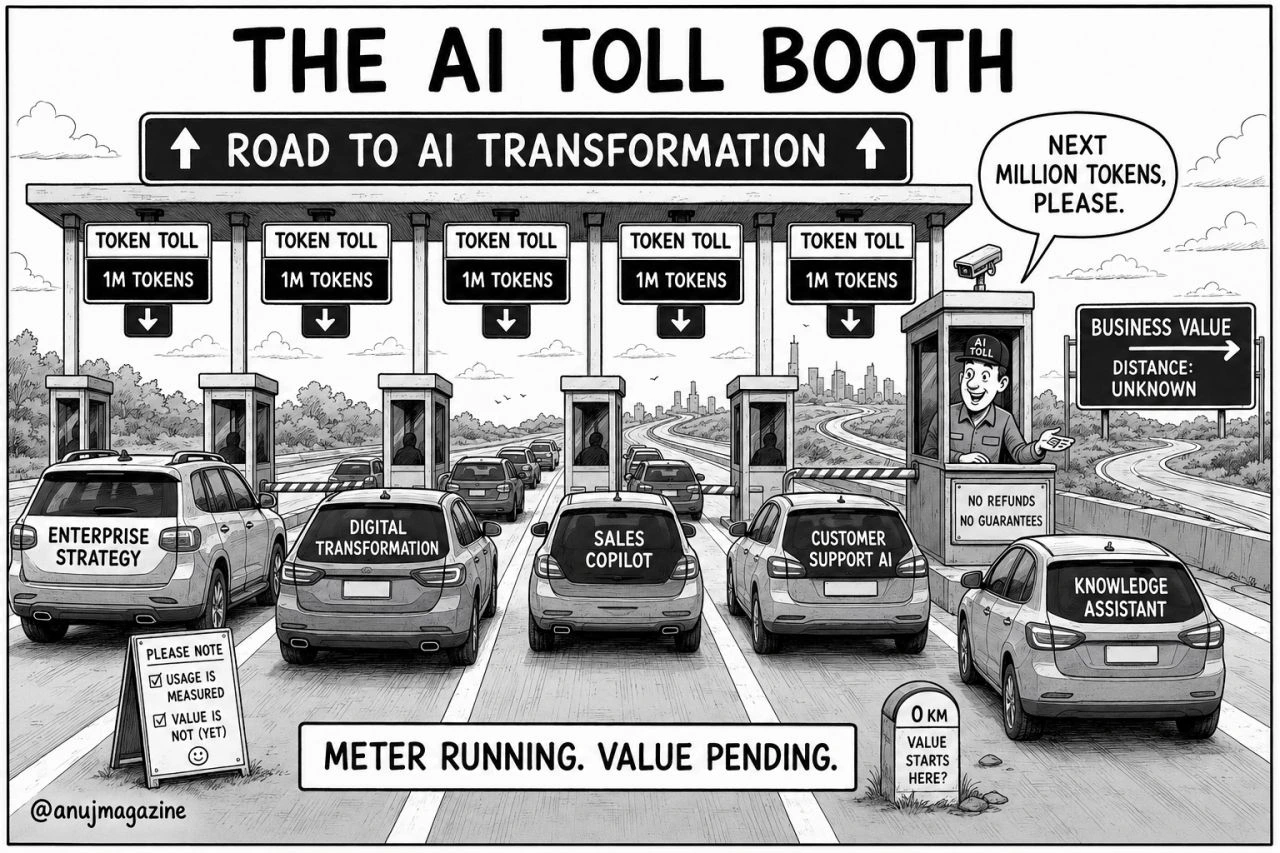
Second: The token pricing model is structurally misaligned with enterprise interests. Businesses are being charged per million tokens processed, with no guarantee of business value in return. (I hope you can relate to the uncomfortable truth in the graphic below.)
Third: Enterprises fear losing control of what actually makes them competitive. When you route your proprietary workflows and internal intelligence through hosted frontier models, you are exposing your moat to someone else’s infrastructure.
Now, to be fair about what’s happening here: Palantir and Nvidia announced a joint Sovereign AI Operating System just days before this interview. A fair amount of what Karp said on that show builds the narrative for buying exactly what they are now selling. So this is a competitor critique as much as it is an industry warning.
But a conflict of interest doesn’t make the critique wrong. Reversibility, data sovereignty, and outcome-based accountability are legitimate questions every enterprise should be pressure-testing in their AI strategy.
Reference: