The $6.34 Billion Job Interview
6 November 2026
On October 29, 2026, about $6.34 billion in digital assets was stolen from Binance, according to reports. It is among the largest crypto thefts on record.
I read through Binance’s incident report and the coverage around it, and the way it happened is more ordinary than the number suggests.
According to Binance’s investigation, the entry point was one software engineer, not a server or a firewall. The attackers reached him through a job-hunting platform, posing as a recruiter, and Binance’s endpoint security tools did not immediately detect the malware. Nine days before the theft, they used that laptop and an internal AI tool to take control of two wallet engineers’ machines, though Binance has not explained how the tool was used.
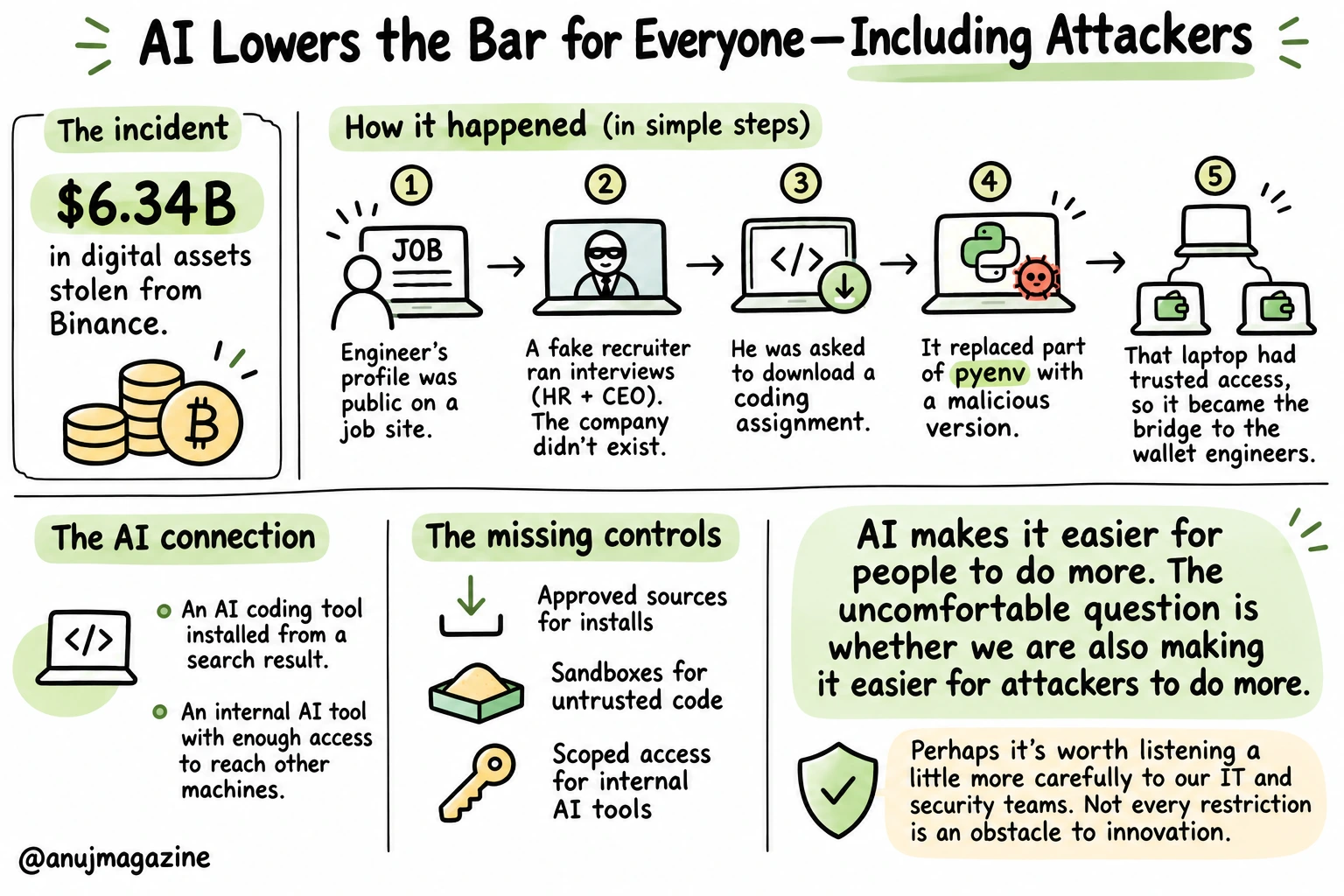
How it was done, in simple terms:
Step 1: The engineer’s profile was public on a job site, so he was easy to find.
Step 2: A fake recruiter offered a role and ran two interviews, one with a supposed HR person and one with a supposed CEO. The company did not exist.
Step 3: At the end, he was asked to download a coding assignment, which is routine in developer hiring.
Step 4: He ran it on his work laptop, and it replaced part of pyenv, a common Python tool, with a malicious version.
Step 5: That laptop already had trusted access inside Binance, so it became the bridge to the wallet engineers.
Binance has since rebuilt the affected AI tool and its access controls.
There is a good learning for enterprises here. In most of the companies we work with, IT and security are seen as the bottleneck to AI adoption: tools blocked, approvals slow, vendor reviews that take months. There is another side to that story.
Two details in this case sit squarely in the AI tooling space: an AI coding tool installed from a search result, and an internal AI tool with enough access to reach wallet engineers’ machines. The same convenience that makes these tools useful makes them a bridge when something goes wrong.
The controls that feel like friction, such as approved sources for installs, sandboxes for untrusted code and scoped access for internal AI tools, are exactly what was missing here.
AI makes it easier for people to do more. The uncomfortable question is whether we are also making it easier for attackers to do more.
Perhaps it’s worth listening a little more carefully to our IT and security teams when they raise concerns. Not every restriction is an obstacle to innovation.
References:
- BleepingComputer — Binance says fake job interview led to $6.3 billion crypto heist
- NPR — Binance crypto exchange cyber heist
- The National — Fake job interviews and internal AI tool used in reported Binance heist