The AI Graveyard
18 July 2026
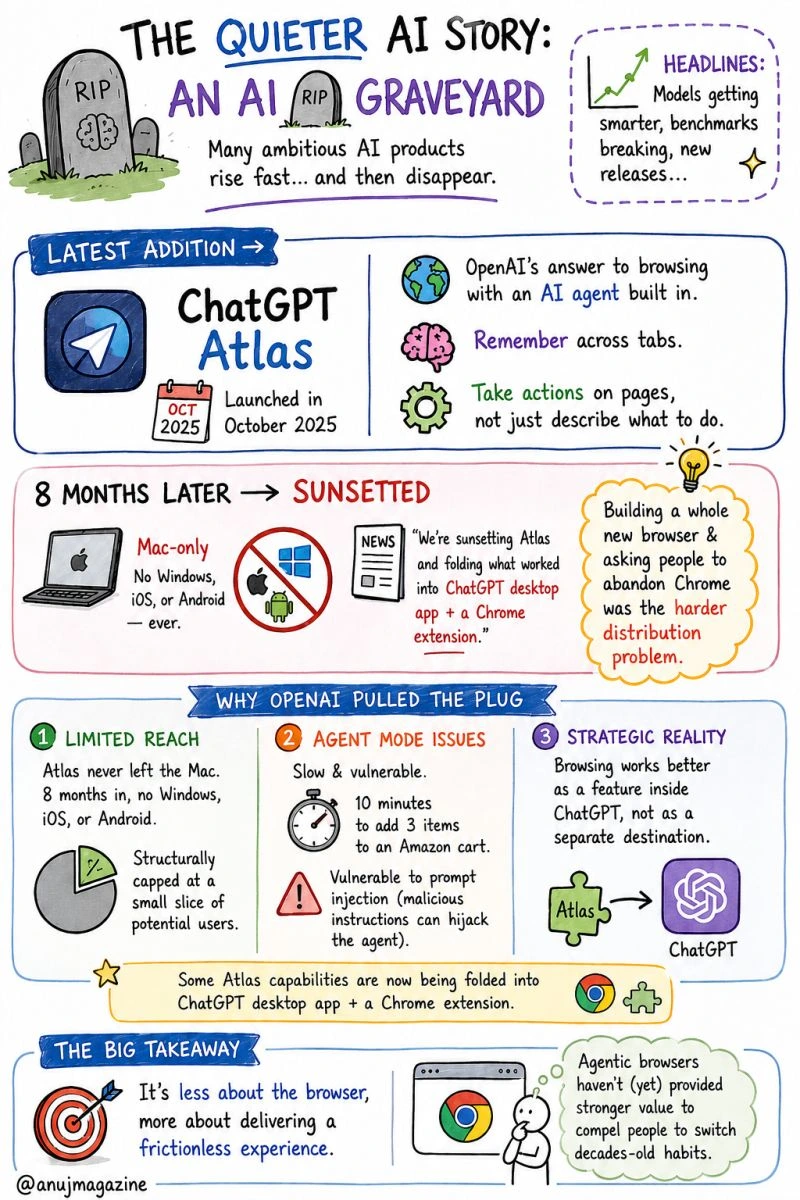
There’s a version of the AI story that’s prominently grabbing headlines—the one about models getting smarter every few months, benchmarks breaking, and whatever the newest release from OpenAI, Anthropic or Google can suddenly do that it couldn’t do the month before.
But there’s also a quieter story running alongside it that doesn’t get nearly as much attention. An AI graveyard: a growing pile of products and features that got announced with genuine ambition and then, within months, just quietly stopped existing.
OpenAI’s ChatGPT Atlas browser is the newest name on that list. It was launched in October 2025. It was positioned as OpenAI’s answer to the question of what browsing looks like in an AI-first world. And yet, eight months in, OpenAI’s Chief Revenue Officer confirmed they are sunsetting it entirely.
A few reasons explain why OpenAI actually pulled the plug.
-
Limited availability: Atlas never really went beyond the Mac. Eight months after launch, there still wasn’t a version for Windows, iOS or Android, which meant the browser was structurally capped at a small slice of potential users, no matter how good the underlying tech got.
-
Slow and vulnerable agent mode: One reviewer clocked ten minutes just to add three items to an Amazon cart. Agent mode was also vulnerable to prompt injection, where a malicious instruction hidden on a webpage could hijack what the AI agent actually did.
-
A strategic shift: Browsing works better as a feature living inside ChatGPT than as its own destination people have to deliberately switch to. Some of Atlas’s capabilities are now getting folded into the ChatGPT desktop app and a Chrome extension instead of disappearing entirely.
It’s less about the browser, more about delivering a frictionless experience. Agentic browsers, so far, haven’t provided strong enough value to compel people to change their decades-old habit of using Chrome.
References:
- Tech Times — OpenAI Kills Atlas Browser After 8 Months
- TechCrunch — OpenAI Is Shutting Down Atlas, but Its AI Browser Ambitions Are Still Growing