When Buying Software Is No Longer the Obvious Choice
13 July 2026
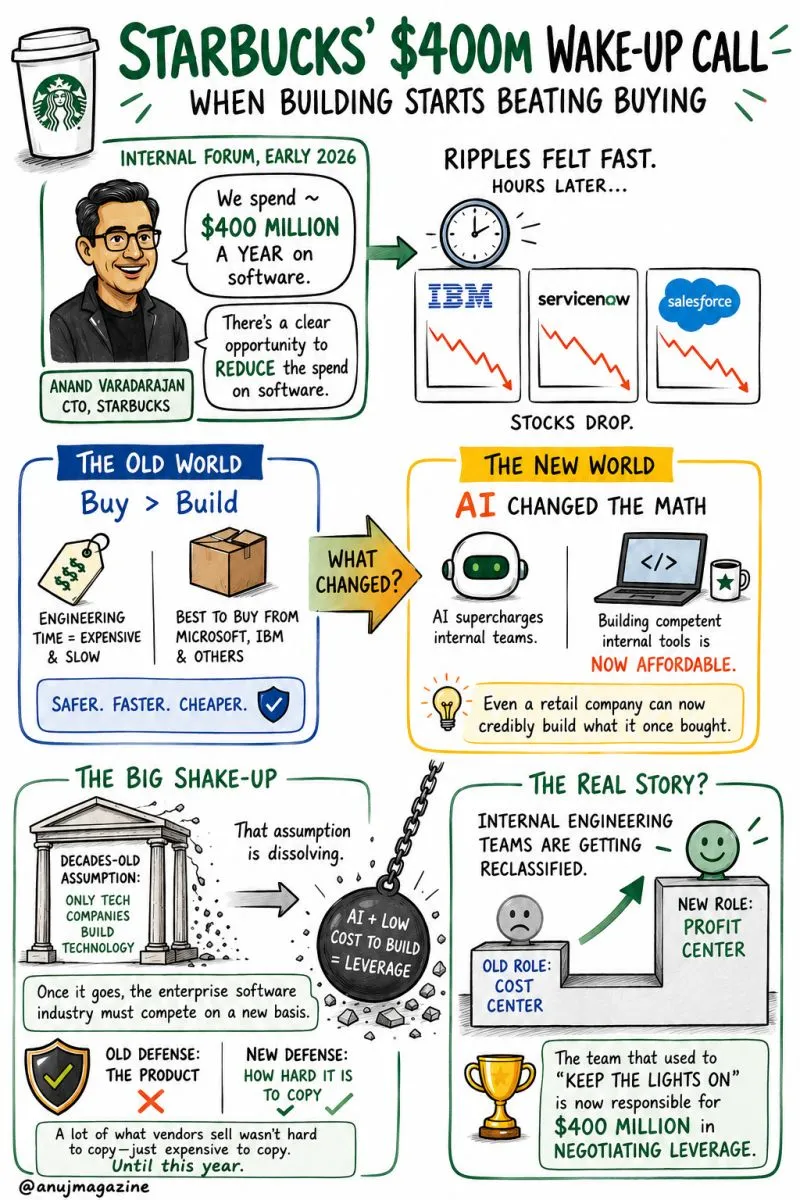
One piece of news that made waves last week: Starbucks’ Chief Technology Officer, Anand Varadarajan, told employees at an internal forum earlier in 2026 that Starbucks spends roughly $400 million a year on software, and said plainly, “There’s a clear opportunity to reduce the spend on software.”
It had a spiraling effect. Within hours, IBM, ServiceNow, and Salesforce stock all dropped.
For most of the last two decades, buying software instead of building it was the obviously correct decision for any company outside the tech industry, because engineering time was expensive and slow, and renting a finished product from Microsoft, IBM, or other vendors was cheaper than assembling a team to build and maintain your own version of the same thing.
What changed isn’t that Starbucks suddenly acquired deep software expertise. It’s that the cost of building competent internal tools, thanks to AI, dropped fast enough that a retail company with no software identity could credibly threaten to replace an inventory system and a maintenance platform on its own timeline.
Whether Starbucks succeeds in this initiative or not remains to be seen. There are enough doubters as to whether AI-written code holds up reliably in production.
Even so, the decades-old assumption that only technology companies build technology is starting to dissolve. And once that assumption goes, the entire enterprise software industry has to compete on a different basis than the one it was built for—where the real defense against being replaced isn’t the product but how hard it is to copy. A lot of what enterprise software vendors sell today was never actually that hard to copy; it was just expensive to copy until this year.
Which is also why this is a story about internal engineering teams getting reclassified from cost centers to profit centers, because the same team that used to just “keep the lights on” is now directly responsible for $400 million in negotiating leverage.
References:
- Bloomberg — Starbucks Taps AI to Reduce Reliance on Microsoft, IBM Software
- Benzinga — IBM Stock Drops After Report That Starbucks Is Using AI to Cut Its $400 Million Software Bill
- Yahoo Finance — Starbucks Replacing Microsoft, IBM Software