The Smartphone Moment for AI Agents?
29 October 2026
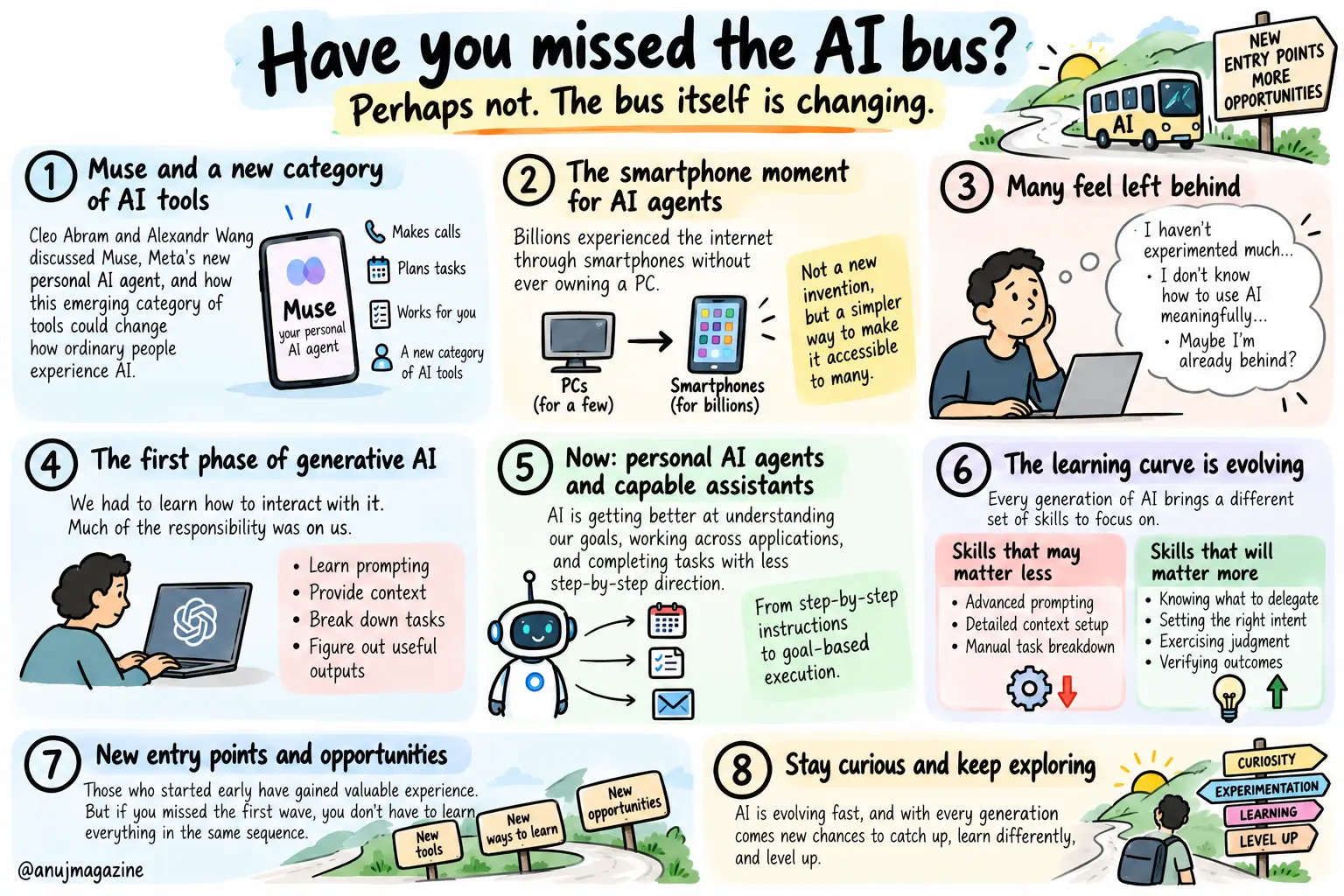
I was watching an interesting conversation between Cleo Abram and Alexandr Wang about Muse, Meta’s new personal AI agent, and how this emerging category of AI tools could change the way ordinary people experience AI.
During the conversation, Cleo asked whether we are witnessing the smartphone moment for AI agents (with the emergence of agents like Muse).
Her analogy was interesting. Billions of people experienced the internet through smartphones without ever having owned or learned to use a PC. Smartphones didn’t invent computing, but made it accessible to a much larger population by simplifying the experience.
Something similar is happening with AI. AI is evolving so quickly that many people I speak with feel they have already been left behind. They haven’t experimented much or haven’t figured out how to use AI meaningfully in their work.
But there is another way to look at this.
The first phase of generative AI required us to learn how to interact with it. Prompting, providing context, breaking down tasks, figuring out how to get useful outputs. Much of the responsibility was on us.
Now, with personal AI agents like Muse and increasingly capable assistants making their way into our workplaces, AI is getting better at understanding our goals, working across applications, and completing tasks with less step-by-step direction.
What’s interesting is that the learning curve itself is evolving with every generation of AI.
Some skills that seemed essential two years ago may become less important, while knowing what to delegate, exercising judgment, and verifying outcomes will matter much more.
Of course, those who started early have gained valuable experience. But those who missed the first wave don’t necessarily have to learn everything in the same sequence.
Every new generation of AI is also creating new entry points and opportunities for people to catch up, learn differently, and level up.
The important thing is to stay curious, keep a close watch on how the technology is changing, and experiment with what’s becoming possible.
Reference: Cleo Abram in conversation with Alexandr Wang (YouTube)