Gemini 4 Argon: The Million-Token Output
23 October 2026
Google launched Gemini 4 Argon almost a week back, and it’s getting a good deal of attention. One of its strengths that’s so little talked about is its 1 million output token limit.
What does it even mean?
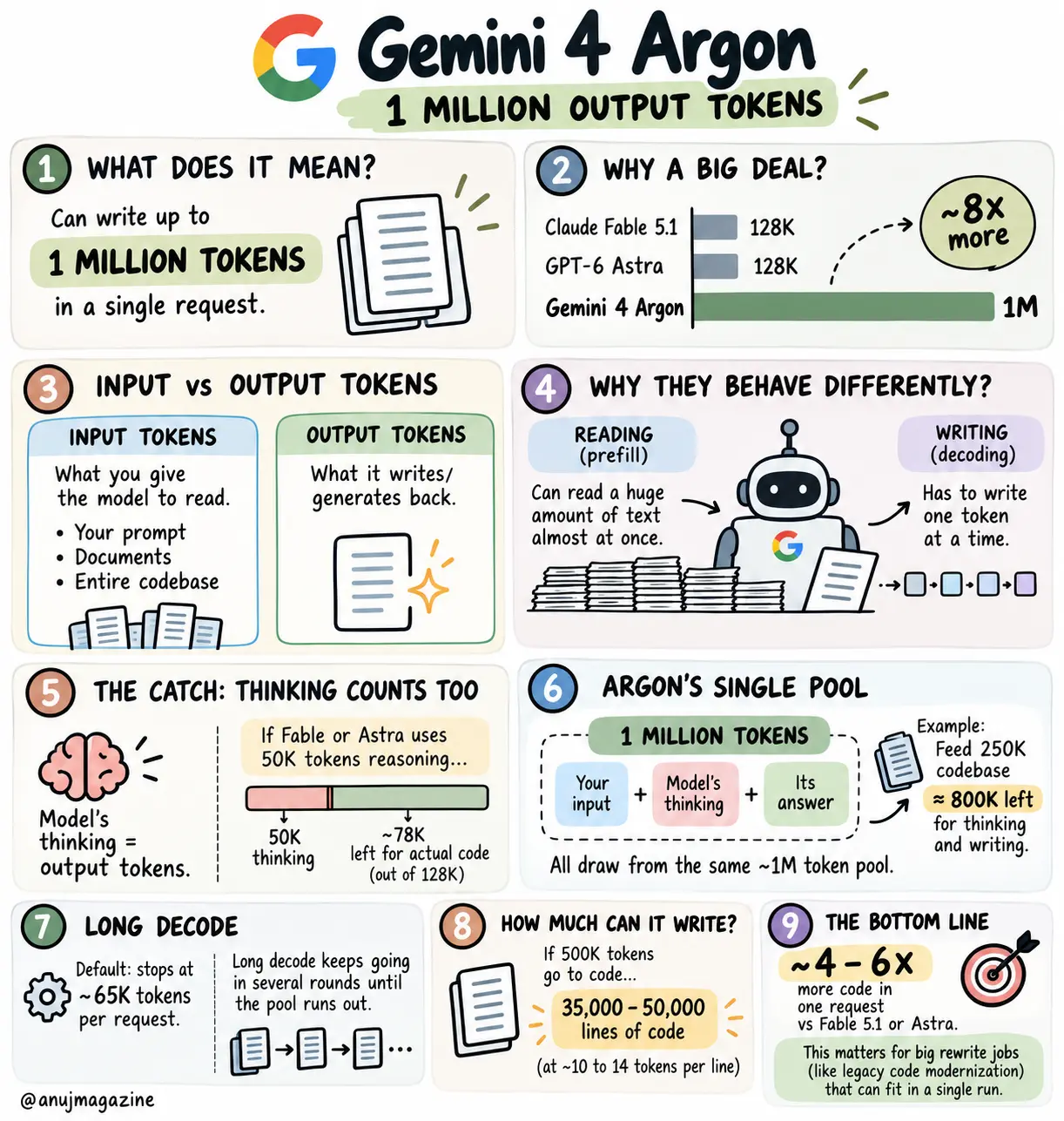
Argon can write up to about 1 million tokens in a single request.
Why is it a big deal?
Claude Fable 5.1 and GPT-6 Astra are limited to 128K output tokens, so that is roughly 8x more.
To understand why that matters, you need the difference between input and output tokens. Input tokens are what you give the model to read: your prompt, documents, an entire codebase. Output tokens are what it writes or generates back.
The two behave very differently. A model can read a huge pile of text almost at once (called prefill), but it has to write one token at a time (decoding). That is why most models now accept around 1M tokens of input while output has been capped much lower.
There is a catch most people miss: the model’s thinking counts as output too.
If Fable or Astra spends 50K tokens reasoning through a messy dependency graph, only about 78K of the 128K is left for the actual code.
Argon works differently. It has one pool of about 1 million tokens, and your input, its thinking and its answer all draw from that same pool. Feed it a 250K codebase and roughly 800K is left for thinking and writing.
By default, it stops at about 65K tokens per request, but a feature called long decode lets it keep going in several rounds until the pool runs out. If 500K of that goes to code, at about 10 to 14 tokens per line, that is 35,000 to 50,000 lines in one job.
That is roughly 4 to 6 times what Fable 5.1 or Astra can write in a single request. They can still get there by splitting the work across several requests, so the gap is about what fits in one job. For big rewrite jobs like legacy code modernization, that is the number that decides how much of the work fits in a single run.
References:
- Google AI — Gemini 4 Argon model documentation
- Google AI — Long decode
- Google Blog — Introducing Gemini 4 Argon