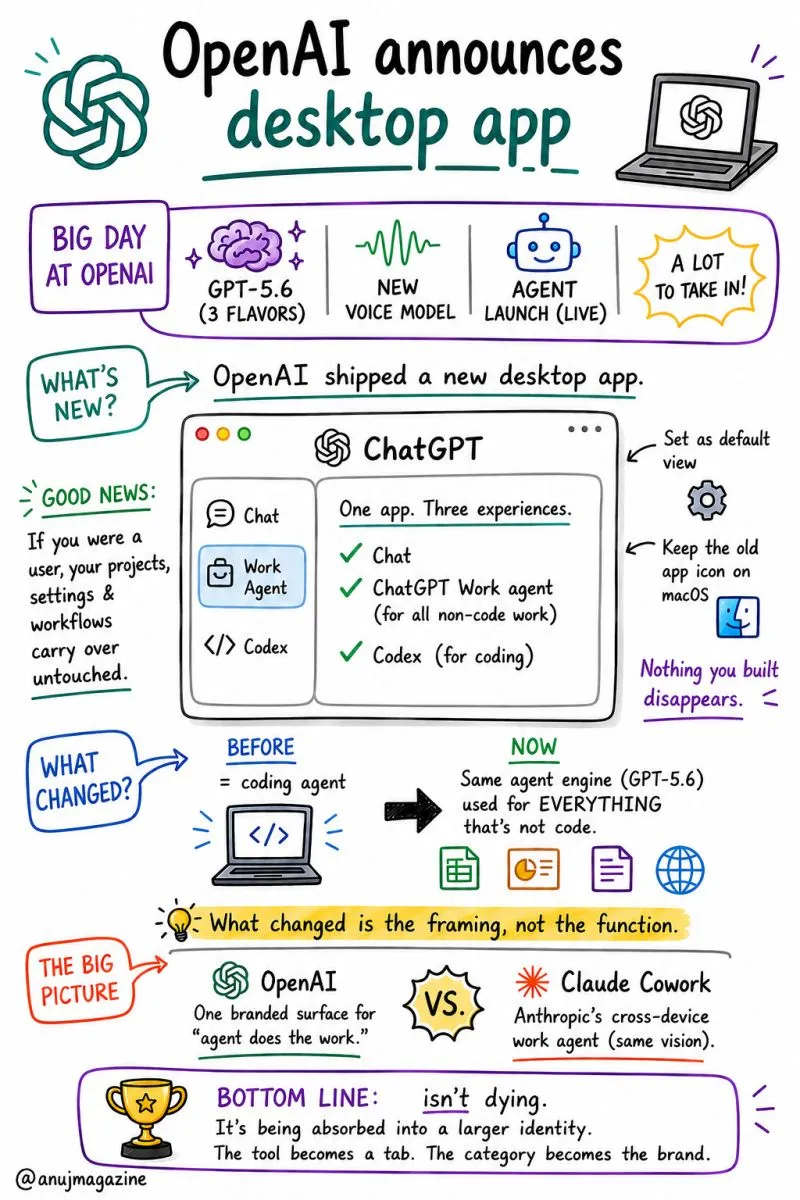
Codex Isn't Dying. It's Becoming a Tab.
10 July 2026
OpenAI announced a slew of updates today, leaving an already overwhelmed world even more so. GPT-5.6 in three flavors, a new voice model, a livestreamed agent launch. As usual, too much to process in one sitting.
So let me focus on just one thing I discovered and used this morning: OpenAI shipped a new desktop app.
I have been a Codex user for a while, so my first reaction was a question. Is Codex no longer needed? Is the brand dying before it even took off?
Here is what actually happened, in plain language.
The standalone Codex app is gone. In its place is one ChatGPT desktop app that holds three things: Chat, the new ChatGPT Work agent, and Codex, all inside the same window. If you were a Codex user, your projects, settings, and workflows carry over untouched. You can even set Codex as your default view and keep the old app icon on macOS. Nothing you built disappears.
What changed is the framing, not the function. Codex was built and marketed as a coding agent. ChatGPT Work is the same underlying agent engine (running on GPT-5.6) pointed at everything that is not code: spreadsheets, slide decks, reports, websites. OpenAI is not retiring Codex; it is generalizing it and folding it under a bigger umbrella.
This move is undoubtedly a shot at Claude Cowork, Anthropic’s own cross-device work agent. OpenAI wants one branded surface for “agent does the work,” the same way Cowork is Anthropic’s single surface for it.
So no, Codex is not dying. It is being absorbed into a larger identity, the same way many strong product names get quietly demoted to a tab once the parent company decides the category, not the tool, is the brand worth building.
References: